Note. The underlying article can be found at https://ajprokop.com/2026/11/23/tis-the-scam-season/
Pip: The holiday shopping season is here, and so is everyone who wants a piece of it — including people who would very much like your AOL password.
Mara: Andrew Prokop lays out exactly how that happens and what you can do about it. Today we’re looking at the anatomy of a modern scam, the scale of the problem, and a tool that might actually help.
Pip: Let’s start with how scammers get in — and what they do once they’re there.
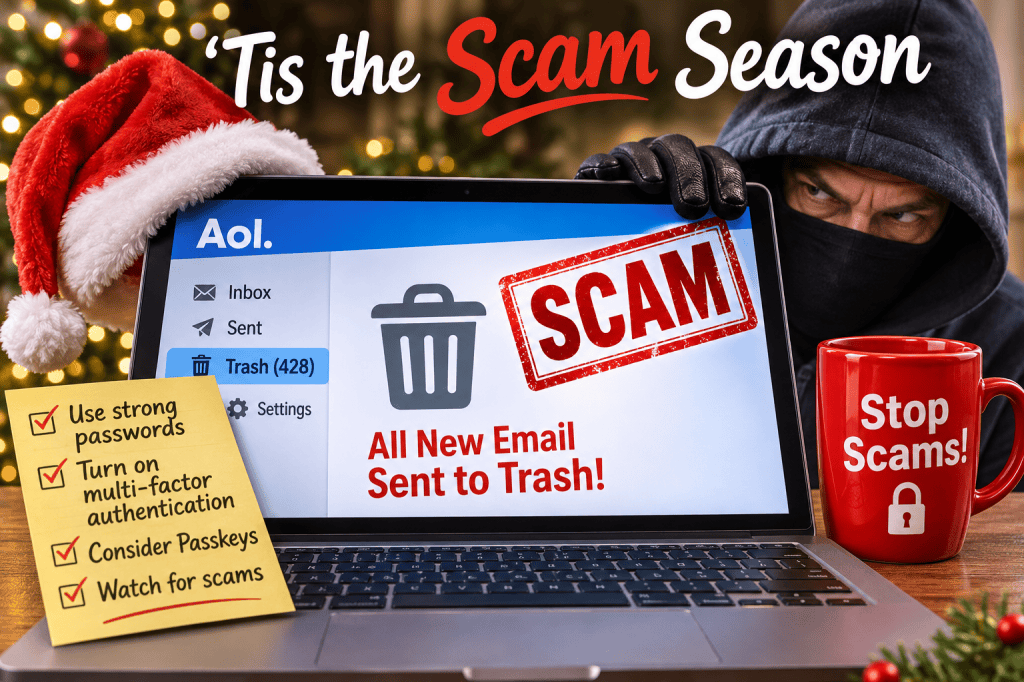
‘Tis the Scam Season
Mara: The post opens with a real case: a friend’s iPhone stopped delivering new emails, and everything was routing silently to Trash — on both the phone and her iPad.
Pip: The post puts it plainly: “Someone got access to her AOL login name and password, added the nefarious filters, and then used her account to attempt password changes on other accounts — think financial and health.”
Mara: So the upshot is that the email account wasn’t the target — it was the tool. Silence the inbox, and you can request password resets on banking or health accounts without the victim ever seeing the alerts.
Pip: And the holiday timing isn’t coincidental. Scammers specifically exploit the bargain-hunting season, and AI has made the setup almost frictionless.
Mara: The post cites Reuters on Meta’s own internal estimates: its platforms show users 15 billion scam ads a day, with roughly ten percent of 2024 revenue projected to come from ads for scams and banned goods.
Pip: Fifteen billion is the kind of number that stops making sense if you think about it too long, so let’s not.
Mara: The post also flags fake reviews as a parallel problem. According to Capital One Shopping research cited in the piece, fake reviews cost consumers worldwide $770.4 billion in 2025, a figure projected to reach $1.07 trillion by 2030 — even as Amazon reported blocking more than 275 million suspected fake reviews in 2024.
Pip: And the post makes the uncomfortable point that the old signals of trust — HTTPS, polished design, a GoDaddy-hosted domain — no longer tell you anything useful. Scam sites have all of them.
Mara: Which is where Scamwise comes in. It’s a suite of free tools — a webpage for analyzing images, text, and links, a mobile app, and a Chrome extension that warns you the moment you land on a fraudulent site, before you buy or sign in.
Pip: The Chrome extension caught a fake storefront within seconds during testing. The post is careful to call this an observation, not an endorsement — it recommends reading the privacy policy before granting access to emails or calls.
Mara: The broader takeaway is practical: use credit over debit online, treat HTTPS as table stakes rather than a trust signal, and keep multi-factor authentication on anything that matters.
Pip: The season for generosity runs both ways — and not everyone giving attention to your inbox deserves it.
Mara: The throughline here is that the threat has outpaced the old rules, but the response is still mostly human — staying skeptical, checking twice, protecting the inbox.
Pip: More on that as the season unfolds.


Leave a Reply