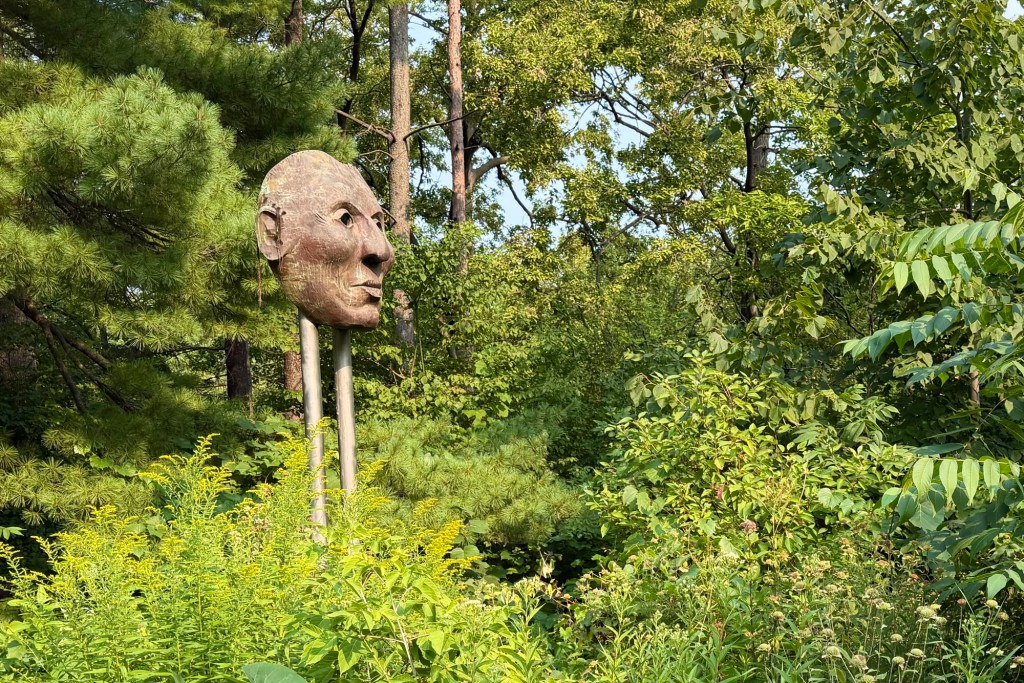
A myth is a way of making sense in a senseless world. Myths are narrative patterns that give significance to our existence.
Rollo May
As many of my readers know, I am an avid biker — as in bicycles. With the exception of the rare rainy day cancellation, I ride from the spring thaw to the first snow of winter. I cannot say for sure how many miles I put on, but my back-of-the-napkin math tells me it’s somewhere north of 3000 miles a year.
Heading out from my house, I have a number of paths to choose from, but nearly every one eventually takes me past Minnehaha Falls. It’s not that the Falls are unavoidable. It’s more that I feel such a strong connection to them that I will go out of my way to add a pilgrimage each day.
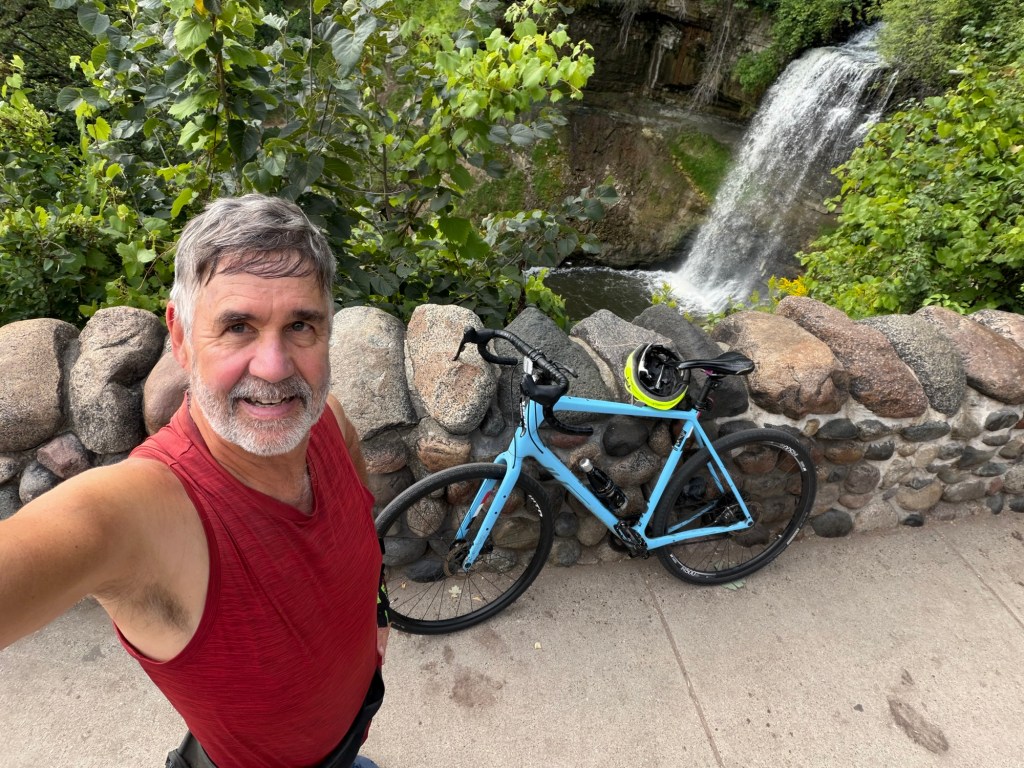
One of my favorite stories about the Falls is when President Lyndon Johnson stopped there for a visit. Unfortunately, Minneapolis was in the midst of a terrible drought and Minnehaha Creek was bone-dry. To avoid standing in front of a silent waterfall, the city opened upstream fire hydrants to feed water into the creek and ultimately the Falls. Disaster was averted and the photo-op saved.
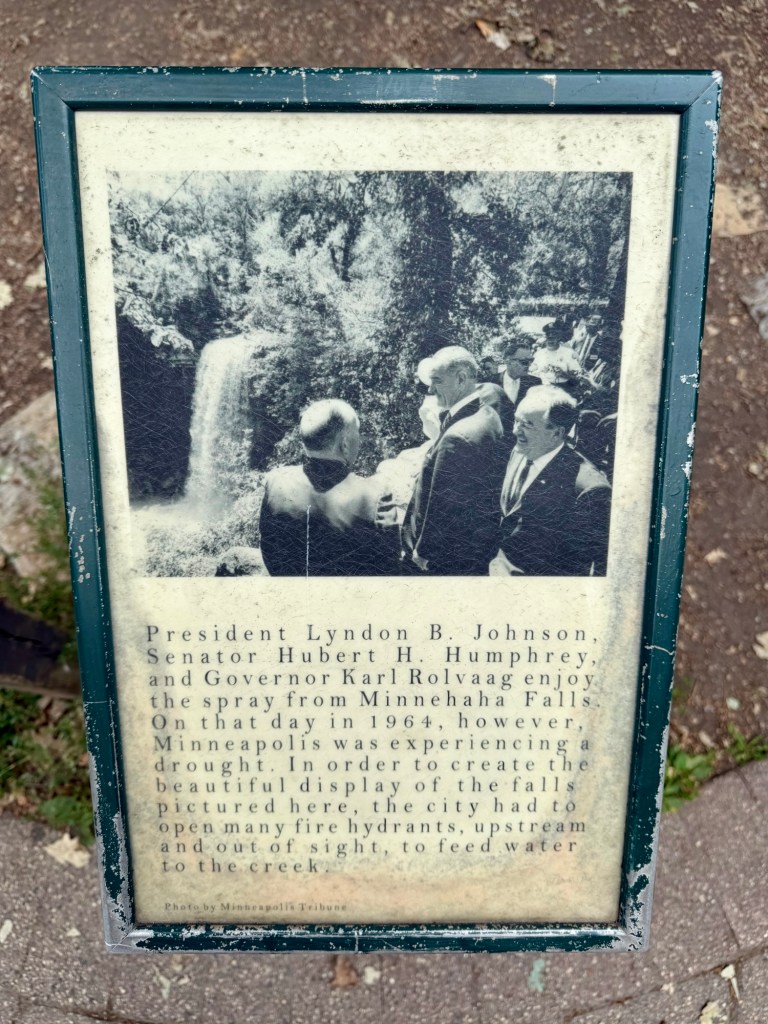
As far as I know, everything about the story is true. However, it doesn’t stop there.
A few feet from the commemorative sign is a slab of concrete with two shoeprints and the words, “President Johnson’s Footsteps.” It’s a wonderful visual that never fails to bring smiles to the faces of the many passersby. I have stood in those footsteps many times and each time I think to myself, “I thought his feet would be bigger.”
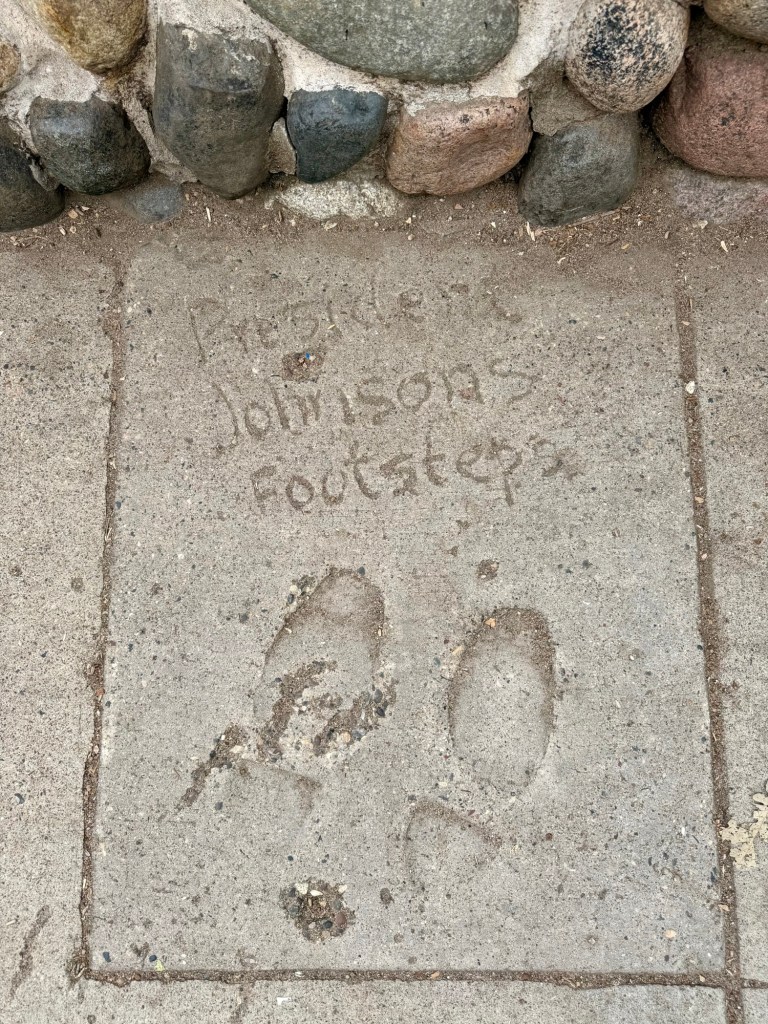
There is only one problem with this. There is no proof that President Johnson ever stood at the Falls in wet concrete. There are no photographs of the act and the only words describing the event are those etched into the slab.
I have spoken to several armchair historians and consistently receive one of four answers.
- They are real.
- The White House posthumously sent Minneapolis a pair of President Johnson’s shoes which were then dunked.
- Someone at Minnehaha Park used a pair of generic men’s shoes.
- The concrete and shoeprints were added in the late 1990s as part of a rebuild of the stone wall above the Falls.
I am a firm believer in the adage, “Don’t let the facts get in the way of a good story.” This leads me to always tell curious visitors that the slab is the real deal even though I am pretty sure the last conjecture is the most likely one. Not only does believing allow people to feel special as they stand in LBJ’s footprints, it adds to the magic of Minnehaha Falls and this world is sorely in need of more magic.
Ultimately, this is what I take away from the President’s visit to the Falls all those years ago. The sign presents the facts and the footsteps create the myth. While it is possible for them to exist independently, told together they become a story greater than the sum of each. They become a story that engages both the mind and our desire for wonder.
Frolicking in the Myth
Despite the fact that my dad was a bit of a tyrant (I am being polite), if you asked Mom about him during her final years she would always say something similar to, “He was a good man. He treated me well and we had a lot of fun together.” I don’t want to speak ill of the dead, but there is no configuration in which any of that is true. He was angry, petty, overbearing, and did horrible things I will not write about.
Still, every time Mom said those words I accepted them as the story she wanted the world to hear. It made her happy to believe her life was a good one and who am I to take that away from her? Mom built a myth for her own purpose and it is perfectly fine that my facts, and ultimately my story, are altogether different.

Throughout this article, I use the word myth rather loosely — not simply to mean a story that isn’t true, but a story used to examine perceived truth from different angles. Sometimes those angles lead us to healthy and affirming places. Sometimes they do not.
The Myths we Build Around Ourselves
Some myths, like Mom’s, can be used to soften harsh memories and find ways to accept complicated truths. I don’t doubt that Mom remembered how difficult Dad could be, but she chose to create a myth of forgiveness. I never pried into her reasons, but I could tell she came to them willingly.
I can think of a number of my own myths that have no grounding in reality and yet like Mom, I allow them to exist. They are essentially harmless and allow me to practice my own form of acceptance and in some cases, forgiveness.
There are also the myths we tell ourselves that do not lead to healthy places. As someone well versed in imposter syndrome, I know that I carry around several myths that do not bring me joy nor do they lead me to a better place. While these imposter myths were more prevalent during my working years, a few have crossed over into retirement. It is my hope that acknowledging and naming them is a good place to start building new, healthier myths.
The Old Strong Stories
The best myths are the ones that teach us something. Perhaps it’s something about the world. Perhaps it’s something about ourselves. One of the previous ministers of my church called them “The old strong stories.” Whether it’s the return of the prodigal son or Odysseus and his battle with the sirens, they are meant to get us to look at our own actions from another viewpoint. While I have never lashed myself to the mast of a ship, I have heard the sirens’ call and know the turmoil that comes from it. It’s a myth I have lived far too often and learned from far too slowly.
Ultimately, these old strong stories are lessons in morality, coping with uncertainty, preserving cultural identity, and human nature. While President Johnson’s footprints don’t say much about ambition, love, betrayal, or redemption, they viscerally connect us with a world long gone by. They allow us to believe that our waterfall is so special that a president of the United States chose to leave his mark for future generations to treasure.
Those footprints, real or not, add greater significance to an event that could easily have been lost to the passing of time. By standing in them, we become a part of the myth and not simply abstract onlookers. They turn the nearby placard into a tactile experience.
As for Mom, hers was a myth of coping. Reframing her life to one of happy memories allowed her to move towards death in a state of peace. She wanted to pass into the next world free from the weighty burden of this one.
A New Alignment
Once upon a time, I chose to place facts high on a pedestal. They were untouchable truths that I could turn to whenever I found myself in a place of doubt. Lost in uncertainty? Reach for a fact. They never lie.
Or do they?
As I have aged, I have discovered that what I thought were facts often turned out to be interpretations, or worse, incomplete understandings. Gone is the mantle of certainty and I no longer look upon them as being carved in stone. Instead, they have become perspectives that evolve as I learn, change, and grow. They are signposts, but they are not the map.
Because philosophy arises from awe, a philosopher is bound in his way to be a lover of myths and poetic fables. Poets and philosophers are alike in being big with wonder. Thomas Aquinas
With this new alignment, myths have found a comfortable place in my life. That is not to say that I reject science and what I perceive to be reality. Far from it. I simply leave room for mystery, uncertainty, wonder, and those old strong stories. A good myth has the power to transform, and these days, I can use all the transformation I can get.
Thank you for reading.
We are born
live
grow
struggle
evolve
we die
Our bodies and minds forever in flux
as real today becomes myth tomorrow
and what we carved in stone is washed away by time and misunderstanding
In the arc of human existence
there is no forever
in the river of time
there is only the island of now


Leave a Reply