Humans think in stories, and we try to make sense of the world by telling stories.
Yuval Noah Harari
Frequent readers of my blog know that nostalgia plays a significant role in my writing. In fact, just last week in Lost in the In-Between I wrote, “I catch nostalgia like a cold.” While I don’t exactly put the past up on a pedestal, it’s a recurring theme in both my written and lived lives. I think about who I was, where I was, and how I was more often than I probably should.
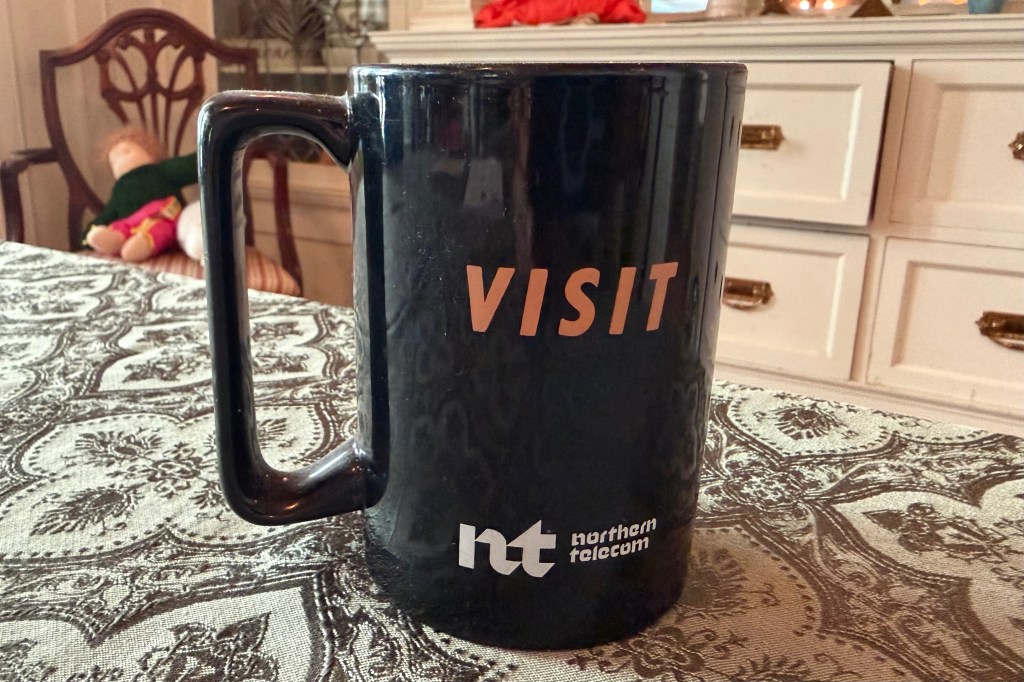
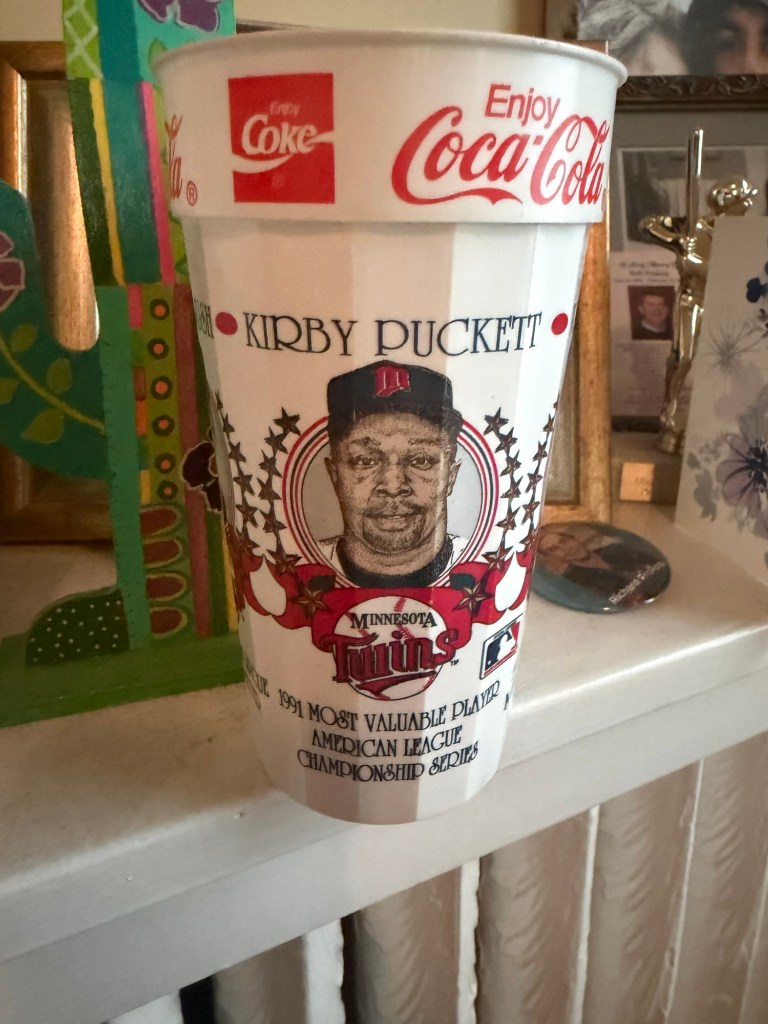
This connection to the past is clearly on display on my desk. From left to right, I see water bottles and mugs from former companies, a mechanical robot given to me by my brother years ago, a space-race coffee can from the late 1960s, and a plastic cup from the 1991 World Series.
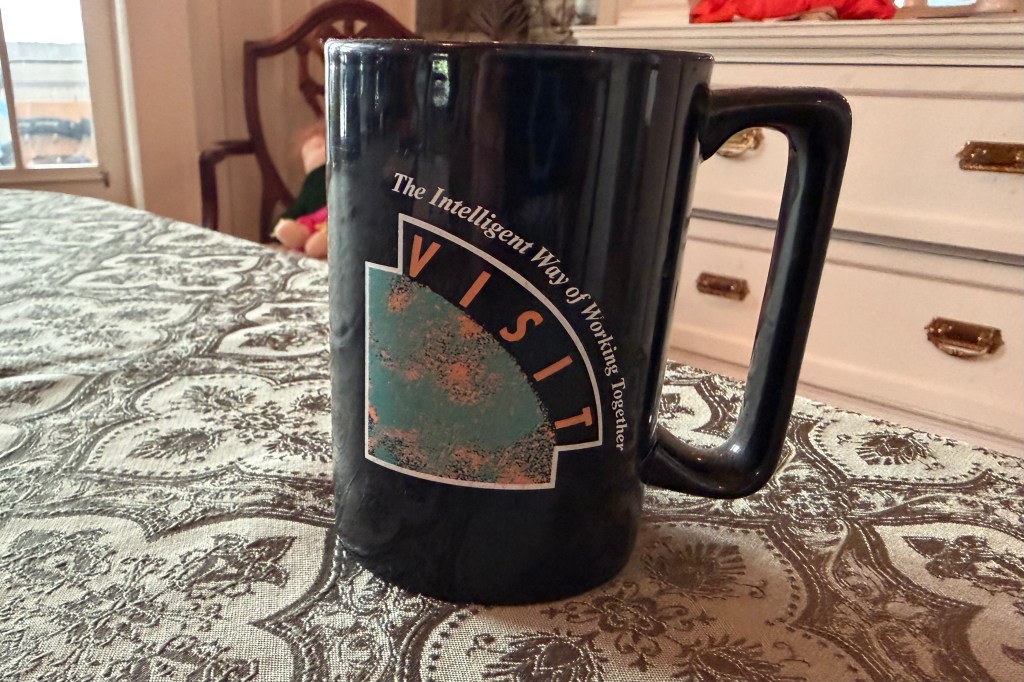
Today, I want to write about one of those items — a Northern Telecom Visit Video coffee mug.
For the unaware, Northern Telecom was a Canadian telecommunications company that began in 1895 as the Northern Electric Company. From there it went through several name changes until it went bankrupt as Nortel in 2013. Northern Telecom, or NT, was the first company I worked for after graduating from Arizona State University. I was there from 1983 until its ultimate and very sad demise.
In the early 1990s, I worked on a product we called Visit. My memory is a little foggy, but I believe that Visit may have stood for Visual Interactive Telephony. Don’t quote me on that, though.
Essentially, Visit was a voice and video collaboration system that predated the likes of Zoom, Google Meet, and Microsoft Teams by decades. It began as voice only on a Macintosh, but within a short period of time it supported Windows PCs and black and white video. Color video came quickly after that.
The Intelligent Way of Working Together
As I looked at the mug, I was struck by three very distinct thoughts.
First, Visit was revolutionary. We were working on bleeding edge technology that was more than just a product. Rather than simply cobbling together existing technologies, Visit was something altogether new and unique. The platform had no real competitors and there wouldn’t be any for years to come. Even Skype was many years away.
Second, I’ve heard it said that “the pioneers are always the first to die” and that is exactly what happened to Visit. It was unique in a world that wasn’t ready for its kind of uniqueness. People were certainly impressed by Visit, but the newness was too much for the vast majority to comprehend and more importantly, buy. Very few people were ready to give up their desk telephone and even more were uncomfortable with showing their faces. Those who bought Visit embraced its Jetson-style telephone calls, but there weren’t enough of them out there to keep the product afloat. Slow sales eventually led to no development dollars and within a few short years, the product was 86ed.
Lastly, the folks who dreamed up and built Visit were a tight team, but here it is years later and I am not significantly connected to any of them. While a few became LinkedIn connections, we don’t talk or write. I find it sad that the people who occupied so many important years of my life could fade to the point where I have forgotten many of their names.
Said differently and far more compactly, my three observations of the mug boil down to:
- Look at what we accomplished.
- Look at how it failed.
- Look at what happened to its developers.
Of course, neither Northern Telecom nor the Visit platform are of any particular importance to my present life. What is important are the things we keep, why we keep them, and the many stories that come with them. That’s what the mug compels me to think about.
A Story to be Told
My friend, Yorgo, is a retired minister. As part of his ministry, he would regularly visit elderly parishioners in their homes. One of his go-to conversation starters was to look around the room and find odd and interesting items. Yorgo called them tchotchkes. He would ask about a tchotchke and then sit back and listen.
In nearly every case, there was a story to tell — especially if the tchotchke was old, worn, and wouldn’t even rate a garage sale “free box.” Great-grandmother’s flower vase evoked the story of a woman who got in a boat a thousand miles away to travel to a foreign land and people. Father’s pipe told tales of poverty, near starvation, and love. A black bow tie told the story of a long-deceased husband who wore it to work for fifty years.
The truth is, we all face hardships of some kind, and you never know the struggles a person is going through. Behind every smile, there’s a story of a personal struggle. Adrienne C. Moore
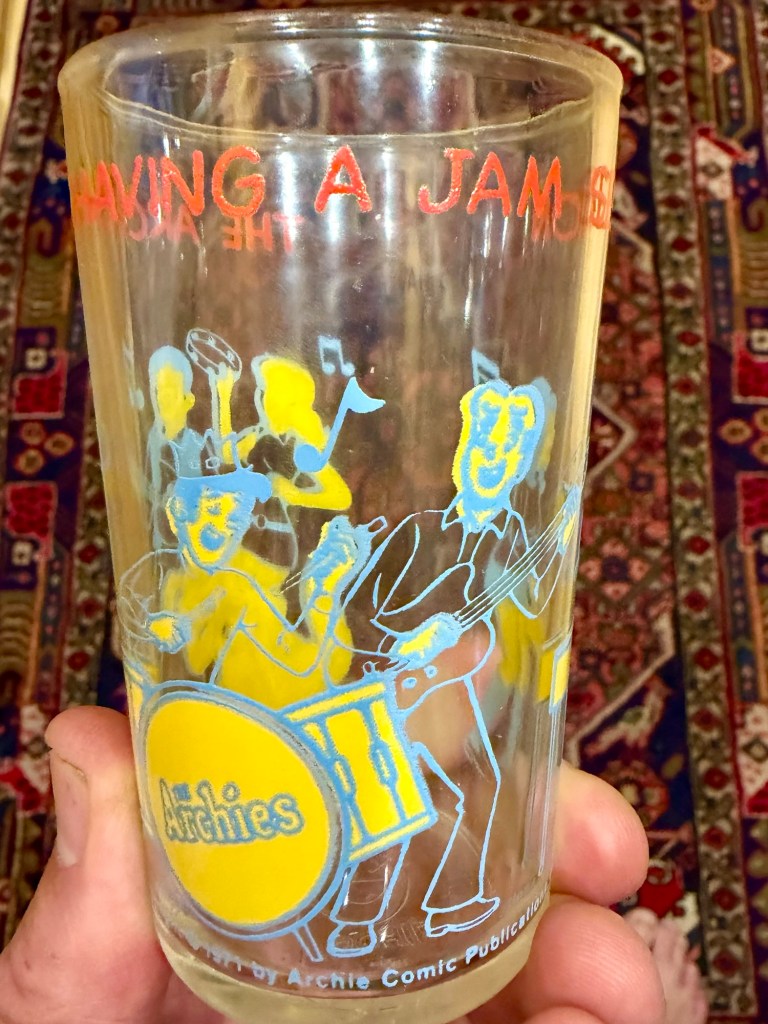
The items themselves have little monetary value except for their connections to people, places, feelings, and times. That is where their importance lies and why they were not thrown out years ago.
Ground Control to Major Tom
Returning to the space-race coffee can on my desk. It’s something I picked up a few years ago while cleaning out Linda’s mother’s garage. I don’t know how it got there or why Linda’s mother kept it all these years. I have no personal connection to the can other than the fact that I love stories about the American race to the moon.
So, why do I still have it? I keep it because when I saw it I immediately thought of my brother, Bob, and his love of outer space. I put it in the trunk of my car with the intention of giving it to him the next time we were together. However, a next time never occurred and Bob passed away without ever knowing about the can.
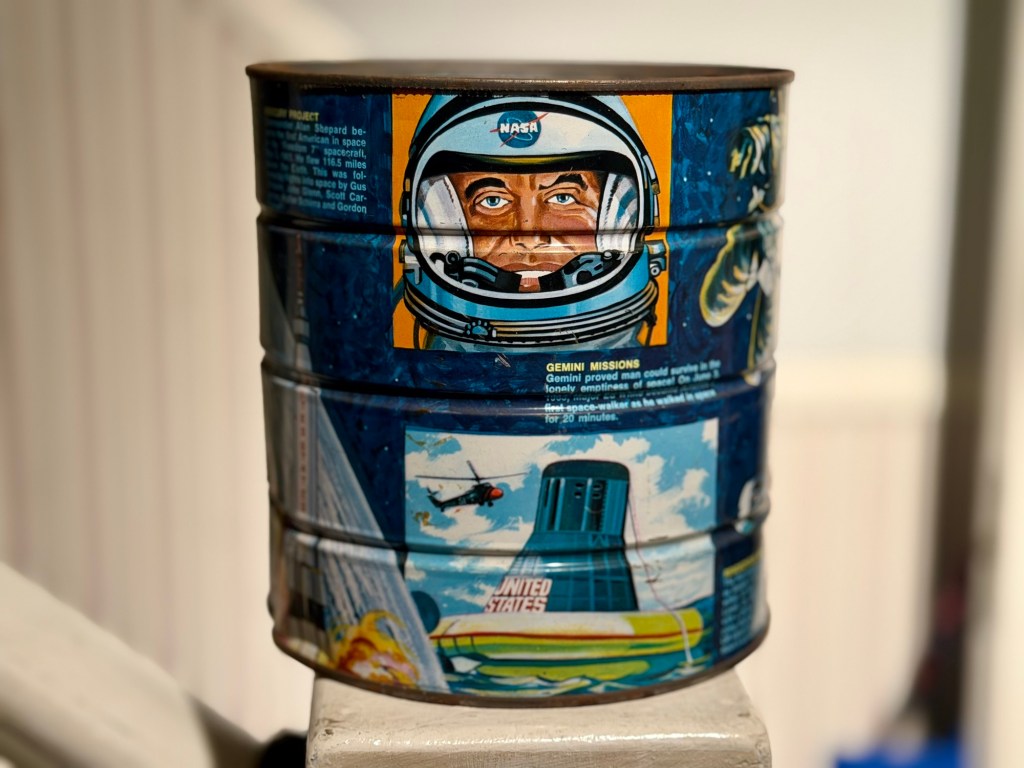
The can remains on my desk as a reminder that some things should not be put off. At a minimum, I should have sent him a picture or boxed it up and popped it in the mail. Instead, I let it sit around until it was too late.
Procrastination is the thief of time. Edward Young
Rather than being a story of the Mercury, Gemini, or Apollo space programs, the can is now the story of someone who never knew it existed. To anyone else, it’s a colorful, but old can. To me, it’s a relationship cut far too short and a man — me — who procrastinated far too long.
I cannot give Bob the can, but I can use the can to tell the story of Bob. That’s not quite a fair trade, but it’s all I have.
Packrat Nostalgia and the Stories of Me
I am far from a hoarder, but I willingly accept the packrat label. I tend to hold onto things well past any good reason to keep them. Whether it’s that plastic 1991 World Series cup or the 4th-place ribbon I won in the Loloma Science Fair, I struggle to throw away my memories.
Call it nostalgia or call it clutter, I hope that someday someone will ask me about my “worthless” tchotchkes so I can tell the stories few people know. Better yet, I hope that upon my death, my family saves a few, displays them on their mantels, and tells stories of me to people I will never know.
These things I’ll be until I die. Brian Wilson
That said, I give them permission to take the Visit mug to the Goodwill. That’s not the kind of story that needs retelling.
Keep the can, though.
Thank you for reading.
This is the story of heartfelt and heartache
knowing love before feeling lost and forlorn
this is the light switch that awakens the new day
This is the disappointment
and the forgiveness after the hurt and hurting
this is the solemn promise that binds two as one
kept until broken
This is the story of help when help is needed
the giving when it’s time to give everything away
These are the visions of life expressed in bits and pieces
like the words of a poem
they are meaningless on their own


Leave a Reply