Note. The underlying article can be found here: https://ajprokop.com/2026/09/28/hong-kong-travelogue/
Pip: Some journals survive the years by accident — a drawer never cleared, a box never tossed — and occasionally that’s a genuine gift.
Mara: Andrew Prokop has been publishing exactly that kind of gift on Can You Hear Me Now. Today we’re spending the whole episode in 1998 Hong Kong, working through a travel journal he kept during a work trip that turned into something much richer than a teaching assignment.
Pip: Let’s start with the flight, the jet lag, the food that defied expectation, and a nighttime view that apparently defied description too.
—
Hong Kong, 1998: A Journal Recovered
Mara: The post opens with a Marcel Proust epigraph about new eyes rather than new landscapes, and that framing holds across the whole journal — this is less a tour guide and more a record of genuine first encounters, written in real time by someone still adjusting to a fourteen-hour time difference.
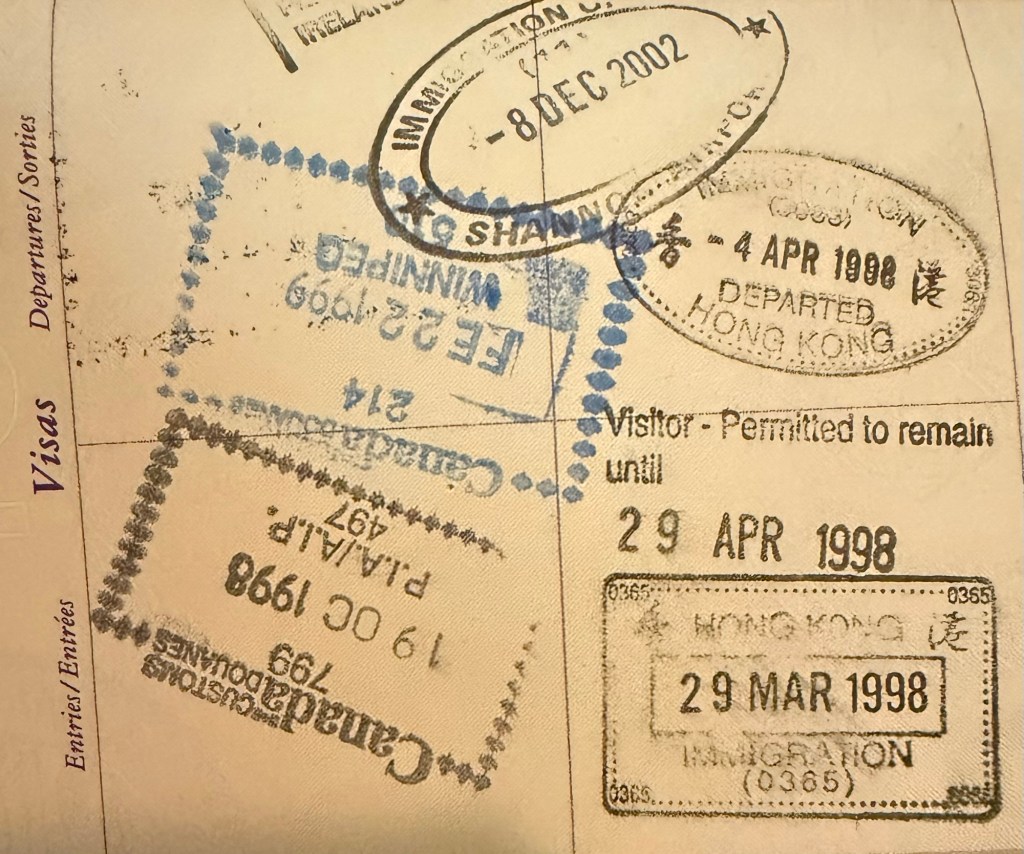
Pip: He sets up the source material honestly: the journal was lightly edited for grammar, no photographs survived the trip, and the product he flew out to teach has long since been forgotten. What remains is the impression.
Mara: And he drops the Proust quote before giving us the first journal entry, which opens mid-flight: “Hong Kong: the Fragrant Harbor. Here I am again. It will take a while before I truly appreciate the length of this flight, which has been extended by at least an hour because of an unscheduled fuel stop in Anchorage.”
Pip: Nineteen hours total, door to door. He brought a twenty-five-dollar guitar instead of a camera, which he acknowledges was probably the wrong call.
Mara: The early entries do the work of arrival — the ride from the airport, the city existing on three vertical levels simultaneously, tunnels under the ground and elevated walkways above it. He writes that the roads “twist and turn like a crazy modern dance” and that even a policeman he stopped to ask for directions wasn’t entirely sure where they were on the map.
Pip: The food section is where the journal really opens up. His hosts treated him to meals he describes with a mix of genuine gratitude and honest discomfort — roast pigeon with the heads still attached, bird’s nest soup made from the saliva of a Chinese sparrow, a hot broth made with toad gelatin served as dessert.
Mara: He’s careful about how he frames it. He writes, “I have always prided myself on being open-minded of food. Here in China, I feel awkward and slightly embarrassed. I have been very polite about each meal and have thanked my hosts profusely for sharing their culture with me, but I always leave the table hungry.”
Pip: That’s a more honest accounting than most travel writing manages — not performed adventurousness, not disgust, just a person sitting with the gap between who he thought he was and what the table actually asked of him.
Mara: The high point of the trip, by his own telling, is Victoria Peak. He went up with colleagues Rui and Lee, first in daylight and then after dark. He writes that the nighttime view “takes the breath away” and compares it to “Christmas and the 4th of July all spread across miles of rugged volcanic shoreline.”
Pip: He knew there was a photograph of himself and Lee at the top somewhere in his house. He couldn’t find it. The epilogue names that loss directly — and then reframes it as something else.
Mara: The epilogue is worth the whole post. He calls the surviving journals “gifts from a younger Andrew to this much older incarnation” and says rereading them takes him back to Galway and Victoria Peak both. The Hong Kong journal and the Ireland journal he published earlier are the two that made it.
Pip: The Friday night trolley ride — upper saloon, neon lights passing close enough to touch — reads as the image he most wanted to hold onto. It’s the one that gets the most careful prose.
Mara: And then the journal ends, the epilogue closes, and he leaves the reader with a short poem. Two halves of a coin, separate but joined. It’s quiet and it lands.
Pip: Memory, travel, the things we almost didn’t write down — that thread runs through the whole post, and it’s worth following wherever he takes it next.
—
Mara: The Proust epigraph earns its place by the end — new eyes, not new landscapes. The journal is the proof.
Pip: A twenty-five-dollar guitar and no camera, and he still came back with something worth keeping. Next time, we’ll see what else surfaces from the archive.


Leave a comment