
My position has always been that the way people age and the signs that we show of aging is nature’s way of tattooing. It’s natural scarification, and the life you lead gives you the symbols and the emblems of your life, the road map you followed.
Frances McDormand
As I wrote about in my article Cyber Fraud: Protect, Recognize, and Recover, I volunteer with AARP as a cyber security specialist. I go to community centers, churches, and assisted/independent living centers to teach folks how to stay safe from scammers.
It’s a rewarding job in several ways. First, I feel that I am doing something beneficial. Cybercrime is a multi-billion dollar industry that often hurts the most vulnerable people. Second, it forces me to stay current on fraud and fraud remediation. Nearly every day I learn something new that I can add to my presentations. Lastly, I get to work with a group of super dedicated, retired people who, like me, are looking for ways to stay engaged in life.
Every so often, the local AARP office gathers us volunteers together for lunch and learn sessions. Last Tuesday, they invited Dr. Rajean P. Moone from the University of Minnesota to speak to us about aging and ageism. His workshop presentation, “A Generation’s Work: Reframing Aging,” addressed ageism as a pervasive form of bigotry that harms both the old and the young. This bigotry affects how we think, how we feel, and ultimately how we act.
He began his presentation by asking us how we define “old age.” For many, old age is tightly connected to changes in our bodies. Bodies break down and become more unfixable. The more they break, the older we become.
For others, it is the point when you know more people who are dying than are being born. I addressed this topic last year in my article, Death Does Not Become Me. I wrote of how in a span of three weeks, five people in my circle of connections had died. While the pace of death hasn’t been as severe this year, it’s only June and three people in my life have passed away.
As for me, old age is when you stop thinking you have something to look forward to. That point when you believe that all your best moments are behind you and there isn’t anything important for you to learn or accomplish. Although he never put it into words, this is what happened with my father. He stopped setting goals and allowed his world to grow so small that it eventually swallowed him up.
What is Age
There are many ways to define age:
Chronological Age: This is the simplest form. I am 66 years old and in a few weeks I will be 67. My youngest grandson just turned three. My oldest son is 41.
Biologic: This involves your physical being. You may be 50 on your driver’s license, but your knees act like they are 70. Are you an early or later grayer? How is your bone density? How is your vision? How many body parts have you had to replace?
Policy Age: These are the numbers you find in government documents and policies. You can legally drink alcohol at 21. You can run for president a at 35. I started receiving Medicare benefits when I turned 65. I need to start Social Security benefits no later than 70-years-old. The Older Americans Act defines an older American as being 60 or older. These days that seems young to me, but nobody asked for my input.
Popular Media: This is the most ageist lens of them all. In the movie The First Wives Club, Goldie Hawn’s character said this about older women actors. “You can play the babe, the district attorney, or driving Miss Daisy.” In Blue Hawaii, Angela Lansbury played Elvis’ mother although she was only 12 years older than he was.
Self Perception: This is how we define ourselves. I remember when I spoke to my mom about taking her to the nearby senior center for games and socialization. She immediately shut me down by saying, “That’s for old people.” Mom was in her late 80s at the time.
Every one of these definitions can be used to create negative or positive perspectives of older people. Even with popular media and its ageism bias, age can be used to portray wisdom and strength. In fact, I’ve seen a number of recent films where an older woman’s age is treated as her superpower — and not necessarily in the Wonder Woman sense.
For more of my thoughts on this, check out my article, How Old Am I.
Storm Clouds on the Horizon
It should come as no surprise to anyone that we are living longer. In 1900, the average life expectancy in the United States was 47. By 1960 it had risen to 70. Today it is around 79.4 and by the year 2060 it will be 82.2.
Ignoring this increased longevity is a dangerous game. Will our aging population have enough money to live comfortably throughout those bonus years? Is the American healthcare system capable of handling this rapidly growing segment of the population. Who will care for those who cannot care for themselves? Where will they live?
Fun fact. A ten-year-old today has a 50% chance of living to the age of 104. Who knows what the percentage and age will be in another 20, 30, 40, or 50 years? We have yet to see just how complicated such longevity means to the world.
Last week, I read of how the Social Security Trust Fund is scheduled to run out of money in eight years. If nothing is done before then, benefits for those receiving Social Security benefits will be cut by 23%. Are our elected officials willing to do what it takes to stop this from happening? The current congressional majority has shown itself incapable of doing anything that will help fix this projected train wreck. They are good at giving money to the wealthiest Americans and stink at helping the rest of us.
Hey, Boomer
Dr. Moone spoke a lot about how we frame aging and that framing begins with the words we use. Years ago, a research group coined the phrase “the silver tsunami.” To my ears, that sounds like older people are something of a calamity. The same goes for words and phrases like “old folks home,” elderly,” “over the hill,” “boomer,” and even “senior.” How many of us immediately picture someone frail, grouchy, and dependent?
If living longer is to be celebrated as a gift, we cannot begin the conversation by treating older people as if they are a burden. This should not be an us vs. them situation. We all want to live long, healthy, and engaged lives.
Moving Forward
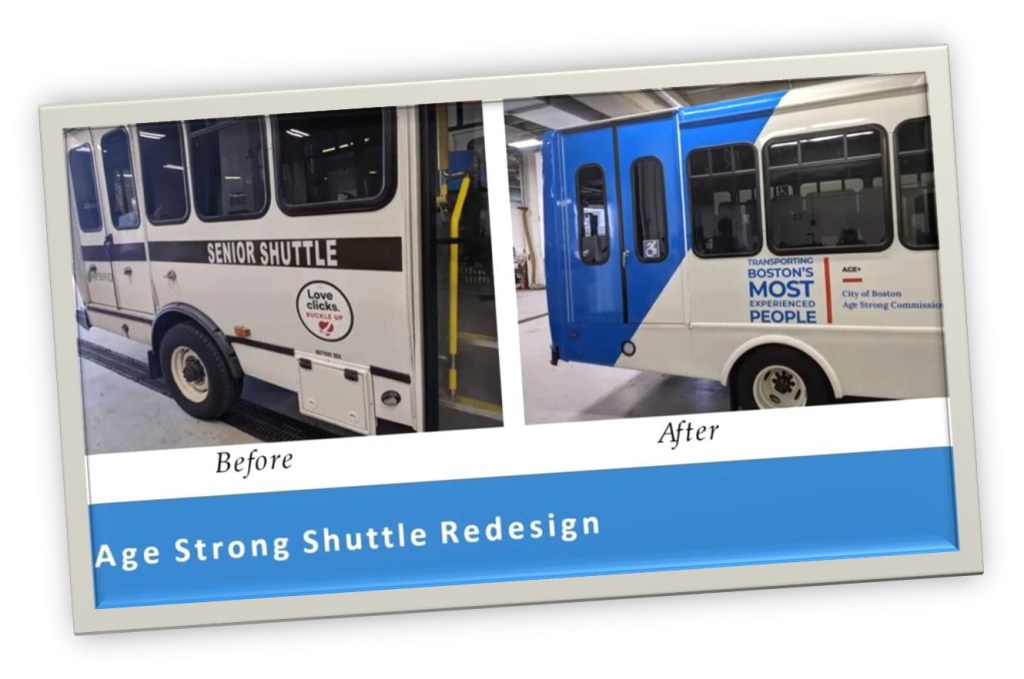
So, how do we move forward? We can start be changing how we speak. Below are before and after photos of a Boston shuttle bus. They went from the age framing “Senior Shuttle” to the more affirming “Transporting Boston’s Most Experienced People.” I know which bus I would rather ride.
We must also recognize that the perceived problems with growing older cross demographic lines. For example, consider the following phrase:
“Feelings of loneliness and isolation can lead to serious consequences for senior health.”
Isn’t it true that loneliness and isolation are detrimental for everyone regardless of our age? Why single out older people as if they are the only ones who are suffering. Instead, how about saying:
“All people have a right to participate fully in our democracy, our economy, and our community life, but our society starts to exclude us as we age.”
This new framing is inclusive while not shying away from the work we need to do.
Dr. Moone describes five traps that we need to eliminate.
- Individualism
- Us vs. Them
- Ideal vs. Perceived Real
- Nostalgia and Threat of Modernity
- Fatalism and Zero Sum Thinking
Here is another phrase to consider:
“Many people who are older are frail, vulnerable, cannot help themselves, and depend on others to meet their most basic needs. This leaves them at risk for all kinds of challenges and potential harms.”
By removing the traps we come up with:
“When community bonds are weak, we are more at risk of experiencing harm. We need to build solid connections and strengthen our social structure to better support older people, families, caregivers, and our entire community.”
We can now address the exact same issue without blaming, shaming, or isolating. They aren’t just old people. They are community and community includes everyone.
Discarded
tired and worn
this old and tattered relic of a day gone by
Exchanged
replaced
traded in for something new and different
But underneath the veneer of aging
beyond the weathered edges and faded façade
Beautiful
perfect
just as it is
just as I am
Still Dreaming After All These Years
Time is the gift that keeps on giving. As a 20-something the thought that I would one day be well past 60 was inconceivable. Back then, 30 was old and 40 was ancient. And yet, here I am along with millions of other older Americans. We had amazing times and we made it through gut-wrenching sorrow. And you know what? We didn’t die, and if everything goes according to plan, we won’t be dying anytime soon.
Speaking for myself, there is so much more I want to do. I retired from corporate life, but I didn’t retire from my dreams. My goals are different than they were ten years ago, but that has always been the case. Us older people have so much to give. Everyone should be so lucky.
Thank you for reading.
She pulls and unfastens
she unclips and lets it drop on the floor
Stepping out and kicking aside
like a burlesque dancer
undulating to unvoiced singing
this flower sheds her pastel petals one by one
Finding her true colors
beneath all those frills

 Can You Hear Me Now
Leave a comment