
Man is an animal that makes bargains: no other animal does this – no dog exchanges bones with another.
Adam Smith
LinkedIn recently suggested that I congratulate one of my connections on his work anniversary. This kind of message isn’t out of the ordinary — social media, after all, is all about building, strengthening and expanding our relationships.
However, this reminder was different and somewhat unsettling. You see, my coworker had died from an aggressive forms of cancer within the past year. So, instead of announcing something to celebrate, the message served as a sad reminder of a very tragic event.
I don’t blame LinkedIn for this. Unless someone steps in and closes my connection’s account, LinkedIn is simply doing what it is supposed to do. You can’t expect it to scan the obituaries and update profiles accordingly.
Or can you?
Erroneous Data
We have all become players in data, big and small. Every time we click on a banner ad, update a status, geotag a photograph, or shop online, we participate in the gathering, classifying, and storing of data about ourselves.
Do you have a grocery store savings card? Did you know that every time you swipe it at the register you are authorizing a record of the items you just purchased? Clearly, someone out there is wondering just what I am going to do with all those bags of candy corn.
We might be willing to share information, or it can be gathered through inference: Andrew likes Spike Lee movies. Spike Lee is a big fan of the New York Knicks. Send Andrew basketball-themed ads.
However, data can become stale, outdated, and downright erroneous. Just because something was once true doesn’t make it true forever. A teenager may like a product at 18 only to shun it at 25. Tastes mature, requirements change, and sadly, life events alter us in unexpected ways. Yet, so much gathered information seems to last forever.
Aware parents instruct their children about the perpetual aspects of the Internet. A photograph that might seem funny now, doesn’t seem nearly as funny when you are applying for a job interview and it’s the first thing a hiring manager sees about you. We pretend that a social media post is like a temporary tattoo that can be easily washed off, while in reality, the ink runs much deeper.
Which brings me back to my LinkedIn dilemma. Clearly, asking me to congratulate a deceased person on a birthday or work anniversary is not what social media should be doing. Yet, do we want it meddling with our lives beyond whatever nebulous boundaries we may have set? Do we want life events automatically triggering online status changes?
A New Currency
The Internet is as successful as it is for a variety of reasons. It’s available nearly everywhere. It connects people to vast amounts of information from a nearly endless number of sources. It’s accessed from an ever increasing number of devices. It comes in every conceivable language.
I would like to add the fact that it provides a wealth of “free stuff.” Yes, you pay for online access, but once online, you are presented with an incredible number of free services. Do you want a mortgage calculator? There are plenty to choose from. Do you want to send emails and instant messages? There are lots of ways to do that, too. I am an active user of LinkedIn, gmail, GitHub, and yet I’ve never paid to use them.
Or have I?
While I may not have shelled out hard currency, I have paid for nearly every Internet service I’ve used. Instead of dollars and cents, though, I’ve paid with personal privacy. I’ve paid with email addresses, phone numbers, a birthdate, photographs, status updates, likes, and “which animal are you” quizzes. Clearly, all these have value to companies willing to write software, host websites, and provide an open front door.
I have long since deleted my Facebook account, but when I had one, I created it willingly and participated nearly daily. However, after only using the platform for a while, it became concerning that Facebook automatically identified the people in the pictures I posted. Of course, it was only because I tagged those people in the past and Facebook’s facial recognition software simply matched the people in my new photograph to the data it previously gathered. Still, it felt weird and uncalled for.
The same went for the ads presented to me. Facebook knew what movies I might be interested in seeing before I had even heard of them. It knew where I want to go on vacation and when I was ready to leave.
This forced me to start thinking more about my social media habits which led to the eventual deletion of my Facebook account. I think twice about sharing my email address with every new service I might be interested in using. I even created a few burner addresses. I also limit my use of those point-of-sale savings cards. The things I purchase should be my business.
The rise of artificial intelligence has only exasperated the problem. The data gathered about us is staggering and it would be impossible for mere humans to evaluate, correlate, and decide how to take action on it. This becomes a piece of cake with AI and the power of the newly created data centers around the country. AI is now looking at our emails and telling us how to respond to them. It has effectively replaced most Internet searches by providing us “the answer” to nearly any question we might have. I actually used that feature twice in the last 12 hours.
On the dark side, AI is being used by authoritarian governments (can you spell USA) to track, identify, and anticipate where we are going. Even that grocery card data can be used in ways we never anticipated. The genie is out of the bottle and it’s watching our every move.
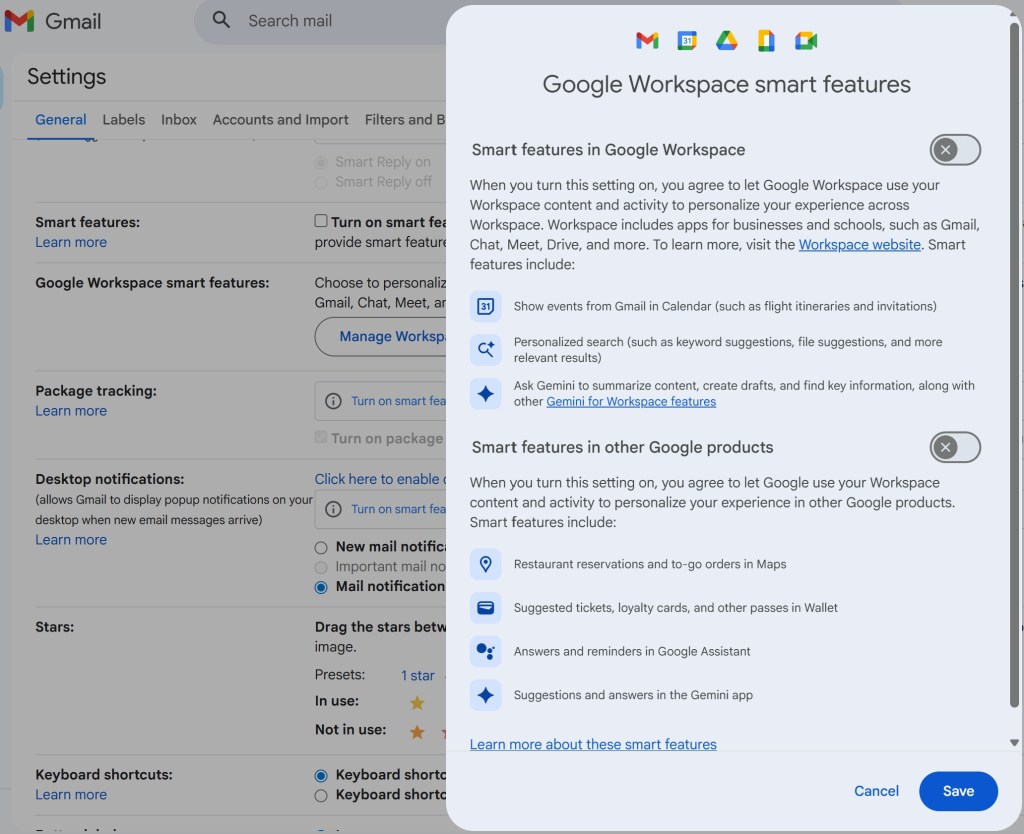
Fun fact. If you use gmail and would like less AI intrusion, go to your account Settings and turn off Smart Features. It doesn’t remove all of Google’s spying, but it’s a good start.
Back to the Future
Let’s get back to where I started this missive: Do I want to receive messages from social media sites about friends and colleagues who have passed on? Are these reminders of mortality and the fragility of life annoying, or are they welcome reminders that some aspects of personal privacy are still respected by the social media giants? And if not respected, then off limits.
I am not at a place in my life where I am willing to jettison all the power and benefits of the Internet in return for a little more control over my personal data. That doesn’t mean that I won’t continue to question my interactions and alter what I am willing to share and how I am willing to share it — this blog included.
It’s a balance that we must all strike. Call it a devil’s bargain or call it the modern world, these questions of privacy continue to haunt me.
Thank you for reading.

See the immensity of life
from the joys to the struggles
from the setbacks to the reasons we start all over again
see the flowers among the garbage
the candles that drive away the darkness
See when eyes are open
but more when eyes are closed
looking from within

 Can You Hear Me Now
Leave a comment