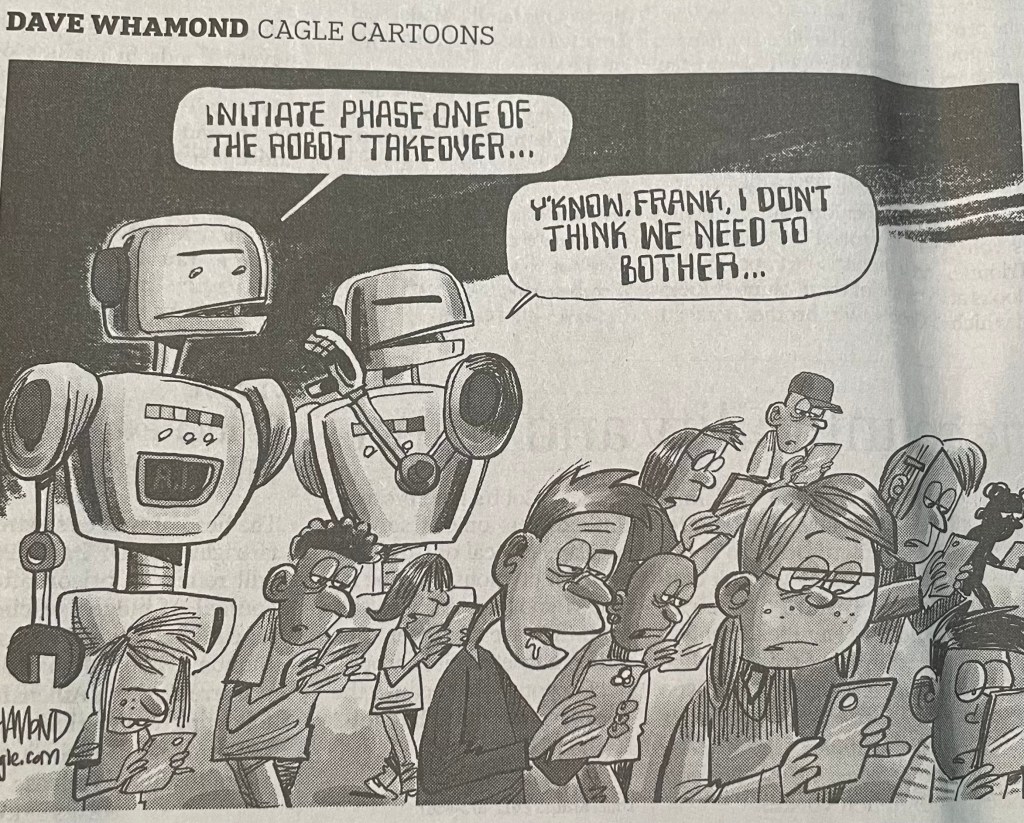
There are more fools in the world than there are people.
Heinrich Heine
Have you noticed the new AI buttons that are showing up on a quite a few LinkedIn posts? Each button consists of a star icon and a question about the post. For example, this one appeared at the bottom of a post about the Kansai International Airport and how after 30 years they’ve never lost a bag.

Some questions are concrete (“Learn more about Kansai International Airport”) and some are more generic and reflective (“How can respect impact professional success”). In all cases, they appear to be relevant to the post’s content.
I even had some appear on the bottom of one of my recent posts about a new blog article I wrote for Can You Hear Me Now. Being the curious guy that I am, I clicked on the question, “What impact does ‘Can You Hear Me Now’ have on readers.”
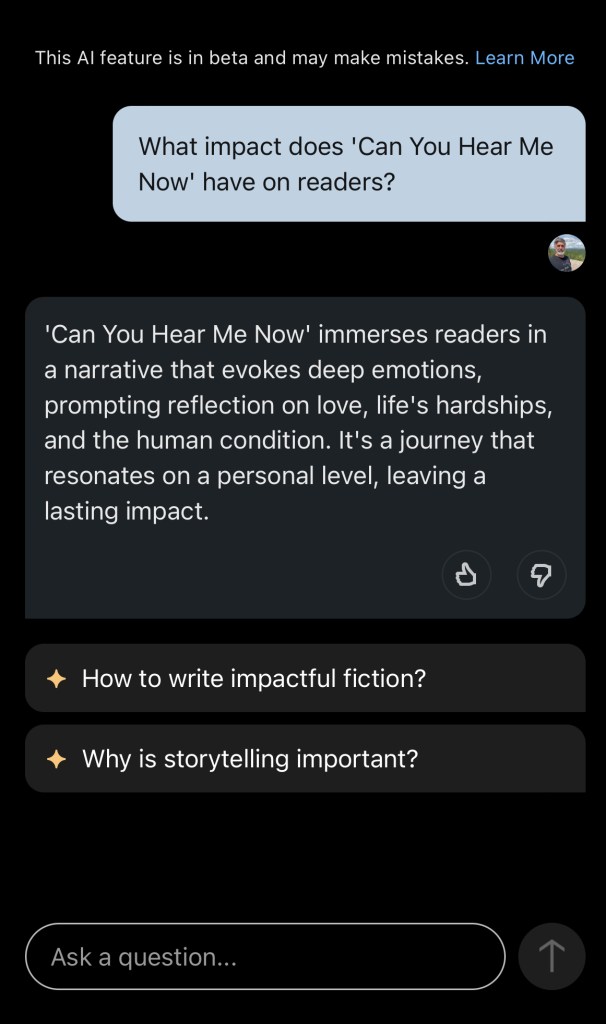
I must admit that I was quite flattered to read all that. While evoking deep emotions and fostering reflections on the human condition are certainly the lofty goals for my blog, I had no idea that after only five posts I was able to achieve them. I expected that it would take me at least a year of writing to find my rhythm.
Of course, the answer is 100% bogus. There is no way that the AI backend knows anything about my blog. It hasn’t read any of the articles, looked at the comments, or counted the likes. It is completely unqualified to offer a single opinion.
Sure, hearing that I am “leaving a lasting impact” made my heart skip a beat, but it could have just as easily called it “a pile of stinking garbage.” Both opinions would have been uninformed and completely worthless.
Worse that worthless, the opinions are misleading. Spouting nonsense under the guise of wisdom does the users of LinkedIn a disservice. Sure, they preface the answer with the statement “This AI feature is in beta and may make mistakes,” but a disclaimer does not make up for outright lies. I would have rather they said “For entertainment purposes only.” At least my smile after reading the gushing answer would have been honest.
How Much AI is Too Much
As is typical with any new and disruptive technology this early in the hype curve, we are hearing that AI can solve everything. Use it for customer support. Have AI look for weakness in your security architecture. Let AI design your business processes. Use ChatGPT to write design documents, user guides, marketing brochures, etc.
While AI may be able to eventually deliver all of the above (and more than we can possible dream up today), the chances are the many of results from these endeavors will be garbage — at least for the foreseeable future. A promise is not a guarantee and not something I would build my business reputation on.
Anyone who has followed my professional work for the past several years knows that I am no AI slouch. I have worked with scores of conversational AI platforms (both generative and intent-based) and built everything from voice bots to image analysis tools. No one can accuse me of being an AI naysayer.
I too have been blown away at what it can do. I have also had it take me down an exciting path only leave me feeling duped. Sometimes the duping is easy to spot, but it can also be quite convoluted and conniving. It’s the latter that gets me in the most trouble and I hate being in trouble.
The point of this missive is not to jettison AI research and development. Rather, it’s to tone down how it is being exposed to the public. Use AI where we can be assured to add real and trustworthy value. Don’t put it in places where it doesn’t work just to make yourself look cutting edge. I am not saying that LinkedIn did that, but it sure smells that way.
Thank you for reading.

 Can You Hear Me Now
Leave a comment